

Time:2026-04-22 Views:0
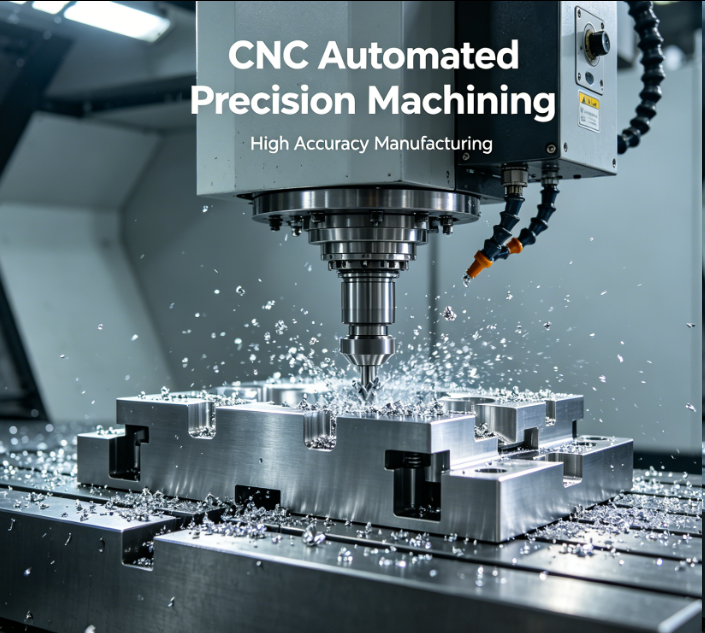
CNC automated precision machining is a advanced manufacturing technology that integrates computer numerical control, automation equipment, and precision machining processes to achieve high-precision, high-efficiency, and low-cost production of mechanical parts. This technology represents the development trend of modern manufacturing, as it can significantly improve production efficiency, reduce labor intensity, and ensure the consistency and stability of product quality. CNC automated precision machining is widely used in high-tech fields such as aerospace, medical equipment, precision instruments, and electronic components, where even micron-level dimensional deviations can affect the performance and reliability of products.
The core of CNC automated precision machining is the integration of CNC machine tools with automated auxiliary equipment, such as robotic arms, automatic loading and unloading systems, automatic tool changers, and online detection equipment. These components work together under the control of a computer system to realize the entire processing process from raw material feeding, processing, tool changing, to finished product unloading and detection without manual intervention. For example, a robotic arm can automatically load raw materials into the CNC machine tool, and after processing, unload the finished product and send it to the next process or inspection station. This fully automated production mode not only improves production efficiency but also avoids human errors caused by manual operation, ensuring that each workpiece meets the strict precision requirements.
Precision is the key advantage of CNC automated precision machining. Modern CNC machine tools have high positioning accuracy and repeat positioning accuracy, which can achieve micron-level processing accuracy. The CNC system uses high-precision servo motors and ball screws to control the movement of the machine tool axes, ensuring that the tool moves precisely according to the preset path. In addition, online detection equipment can monitor the processing process in real-time, detect dimensional deviations in time, and feed back the information to the CNC system, which automatically adjusts the processing parameters to correct the deviations. This closed-loop control system greatly improves the processing accuracy and stability of the workpieces.
Another important feature of CNC automated precision machining is its flexibility. The CNC system can store multiple sets of processing programs, allowing for quick switching between different workpieces. This is particularly suitable for small-batch, multi-variety production, which is increasingly common in modern manufacturing. For example, in the medical equipment industry, different types of precision parts need to be processed according to the needs of different patients, and CNC automated precision machining can quickly switch processing programs to meet the diverse needs. Moreover, the automation of the processing process reduces the dependence on skilled workers, as the system can complete the processing work with minimal manual operation, which helps to solve the problem of labor shortage in the manufacturing industry.
In addition to improving efficiency and precision, CNC automated precision machining also helps to reduce production costs. The automated production mode reduces labor costs, and the high processing accuracy reduces the waste of materials caused by dimensional deviations. Moreover, the long service life of CNC machine tools and the reduced frequency of tool changes also help to reduce maintenance costs. With the continuous development of artificial intelligence and the Internet of Things, CNC automated precision machining is moving towards a more intelligent and networked direction. For example, intelligent CNC machine tools can predict potential failures through data analysis, perform predictive maintenance, and improve the reliability and service life of the equipment. In summary, CNC automated precision machining is a core technology in modern manufacturing, which has important significance for improving the competitiveness of enterprises and promoting the development of the manufacturing industry.
 China management center add.
204, Building A, Phase 3, Jiewei Industrial Park, Shangmugu Community, Pinghu Street, Longgang District, Shenzhen, China
 Headquarters tel.
+86 134 3077 5139
 E-mail.


 CN
CN


