

Time:2025-12-01 Views:0
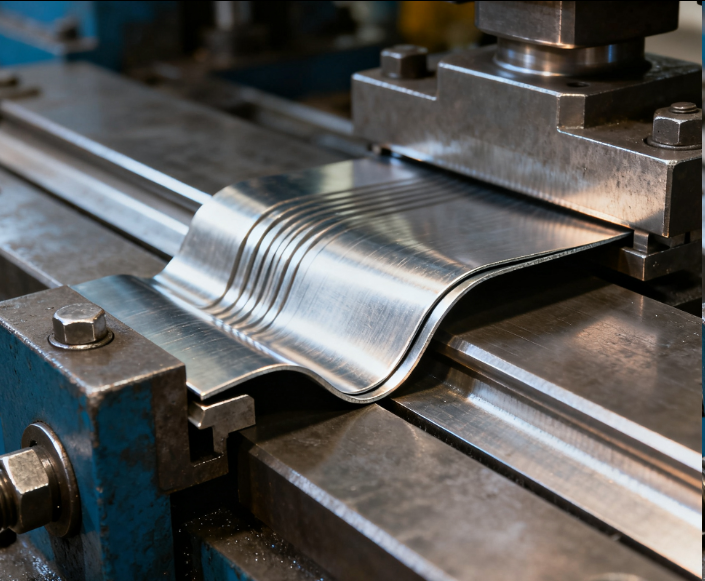
Stamping part bending is a fundamental forming process that shapes flat metal sheets into angular or curved geometries—used to create components like brackets, hinges, and enclosures across industries such as automotive, electronics, and construction. This process relies on applying force to a metal sheet using a punch and die, causing the material to deform plastically along a predefined bend line. Success in bending depends on precise control of parameters like bend angle, bend radius, and material properties to avoid defects such as cracking, wrinkling, or springback.
Key parameters in bending start with the bend radius—the internal radius of the bent part. A radius too small can cause the outer fibers of the material to stretch beyond their tensile limit, leading to cracks; a radius too large reduces dimensional accuracy and may require additional trimming. Industry standards recommend a minimum bend radius based on material thickness and type: for example, low-carbon steel (SAE 1008) typically requires a minimum radius of 0.5 times the material thickness (t), while aluminum alloys (e.g., 6061-T6) need a larger radius (1.5t) due to lower ductility. The bend angle is another critical parameter, defined as the angle between the two flat sections of the bent part. Inspectors use protractors or digital angle gauges to verify the angle, with tolerances often as tight as ±1° for precision parts.
Tooling design also impacts bending quality. The die’s V-width (the distance between the die’s two sides) is typically 6–10 times the material thickness to ensure uniform deformation. The punch’s shape (sharp or rounded) matches the desired bend radius, and the punch force is calibrated to avoid overloading the material. Common defects in bending include springback—where the material elastically recovers after the punch is removed, reducing the final bend angle. To counter springback, manufacturers use overbending (bending the part slightly beyond the target angle) or bottoming (applying additional force to the bent part to set the shape). By optimizing parameters and tooling, stamping part bending produces consistent, high-quality components that meet dimensional and performance requirements.
 China management center add.
204, Building A, Phase 3, Jiewei Industrial Park, Shangmugu Community, Pinghu Street, Longgang District, Shenzhen, China
 Headquarters tel.
+86 134 3077 5139
 E-mail.


 CN
CN


