

Time:2025-12-05 Views:0
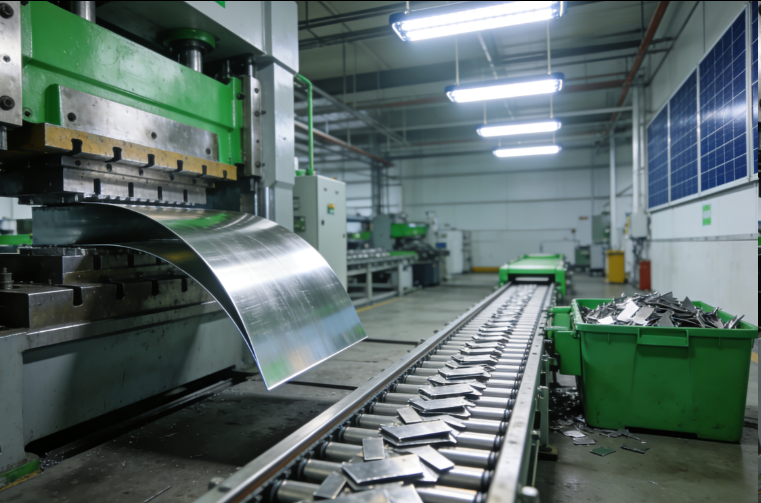
Green Manufacturing within the stamped metal parts industry involves a comprehensive strategy aimed at minimizing environmental impact throughout the entire product lifecycle, from raw material procurement and production processes to end-of-life recycling. Given that stamping is an energy-intensive process dealing with high-volume metal sheets, the application of sustainable practices directly addresses significant environmental challenges, including energy consumption, material waste, and hazardous substance use. This commitment is driven by tightening global regulations, consumer demand for sustainable products, and the pursuit of long-term operational cost reductions.
The core principle of green manufacturing in stamping is material efficiency and optimization. The greatest opportunity for environmental impact reduction lies in minimizing the amount of scrap generated during the blanking and punching operations. Advanced simulation tools, integrated into the design phase, are utilized to run sophisticated nesting and yield optimization algorithms. These tools meticulously arrange the part geometries on the metal sheet (coil) to achieve the highest possible material utilization rate, reducing the scrap ratio below industry averages and conserving virgin metal resources. Furthermore, manufacturers are increasingly using lighter-gauge and high-strength steels (HSS) or aluminum alloys, which require less material to meet structural requirements, thereby reducing the mass of the final product and lowering fuel consumption in downstream applications like automotive.
Energy efficiency is another cornerstone. Green stamping facilities strategically implement technologies to reduce the high electrical demands of presses. This includes the deployment of servo-electric presses instead of traditional hydraulic or mechanical presses. Servo presses use energy only when they are actively forming the part, allowing for energy recovery during the return stroke and enabling precise control over the slide motion. This often results in up to 30-50% energy savings compared to conventional systems. Additionally, adopting Electronically Commutated (EC) motors for cooling fans, air compressors, and lubrication pumps—all significant consumers of ancillary power—contributes to overall energy conservation within the factory.
Beyond the press itself, green manufacturing extends to process fluids and waste management. Manufacturers are transitioning away from oil-based stamping lubricants to minimum quantity lubrication (MQL) systems or dry forming lubricants, which use significantly less fluid, reduce the need for hazardous waste disposal, and simplify the cleaning processes required before secondary operations like welding or painting. Moreover, robust, automated scrap sorting and recycling programs are implemented to ensure that virtually 100% of the generated metal waste is recovered and returned to the metal supply chain, closing the material loop and minimizing the reliance on primary resource extraction.
Finally, green practices incorporate facility-level initiatives, such as the use of renewable energy sources (rooftop solar PV), advanced HVAC and lighting controls, and water conservation measures. By embracing these integrated strategies—from optimizing material layout and switching to energy-efficient machinery to managing process fluids responsibly—the stamped metal parts industry moves toward a more sustainable and economically responsible model of production.
 China management center add.
204, Building A, Phase 3, Jiewei Industrial Park, Shangmugu Community, Pinghu Street, Longgang District, Shenzhen, China
 Headquarters tel.
+86 134 3077 5139
 E-mail.


 CN
CN


