

Time:2026-01-27 Views:0
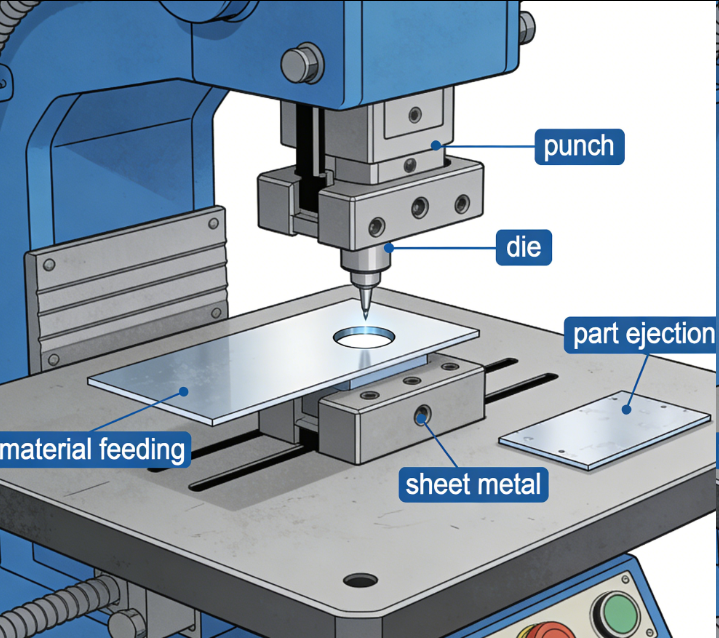
Sheet Metal Punching Processing is a core manufacturing technique used to create precise holes, slots, notches, or custom shapes in sheet metal materials (such as steel, aluminum, copper, and stainless steel) with thicknesses ranging from 0.1mm to 20mm. This process relies on a punch press—a machine equipped with a punch (a sharp, hardened steel tool) and a die (a matching cavity)—to exert high pressure, forcing the punch through the sheet metal and into the die, thereby separating the desired shape from the material. Unlike laser cutting (which uses heat) or waterjet cutting (which uses high-pressure water), punching is a cold-forming process, meaning it does not generate heat-affected zones (HAZ) or cause material warping, making it ideal for applications requiring tight tolerances and structural integrity.
One of the key advantages of sheet metal punching is its high precision and repeatability. Modern punch presses, especially CNC (Computer Numerical Control) models, can achieve hole tolerances as tight as ±0.01mm, ensuring consistency across large production runs—critical for industries like automotive, aerospace, and electronics, where component interchangeability is essential. For example, in automotive manufacturing, punching is used to create mounting holes in sheet metal chassis parts, with each hole’s position and size needing to align perfectly with other components during assembly. CNC punch presses also support complex punching sequences, allowing for the creation of multiple hole types (round, square, rectangular, hexagonal) or custom cutouts in a single setup, reducing production time and labor costs.
Sheet metal punching offers versatility in terms of material compatibility and design flexibility. It works with a wide range of sheet metal alloys, including mild steel (used for structural parts), aluminum (lightweight for aerospace components), and stainless steel (corrosion-resistant for food processing equipment). Additionally, specialized punches and dies can create features beyond basic holes, such as embossments (raised patterns for strength or branding), louvers (slots for ventilation in electrical enclosures), and dimples (small indentations to reduce material thickness in specific areas). For instance, in electrical panel manufacturing, punching is used to create louvers that allow airflow while protecting internal components from dust and debris.
The efficiency of sheet metal punching is another standout feature, especially for high-volume production. CNC punch presses can process up to 1,000 holes per minute for small, simple holes, significantly outpacing other cutting methods. They also support automated material handling, such as robotic loaders and unloaders, which minimize human intervention and reduce the risk of errors or material damage. Additionally, punching produces minimal waste compared to other processes—scrap material is typically in the form of small slugs, which can be easily collected and recycled, aligning with sustainability goals.
To ensure optimal results, sheet metal punching requires careful consideration of several factors, including material thickness, punch and die clearance (the gap between the punch and die, which must be tailored to the material to prevent burrs or material deformation), and punch speed (adjusted to avoid material tearing). Post-punching processes, such as deburring (removing sharp edges) or chamfering (smoothing hole edges), may also be necessary to meet application requirements. With its precision, versatility, and efficiency, sheet metal punching processing remains a cornerstone of modern manufacturing, supporting the production of countless components in industries ranging from automotive and aerospace to electronics and construction.
 China management center add.
204, Building A, Phase 3, Jiewei Industrial Park, Shangmugu Community, Pinghu Street, Longgang District, Shenzhen, China
 Headquarters tel.
+86 134 3077 5139
 E-mail.


 CN
CN


