



Time:2026-05-12 Views:0
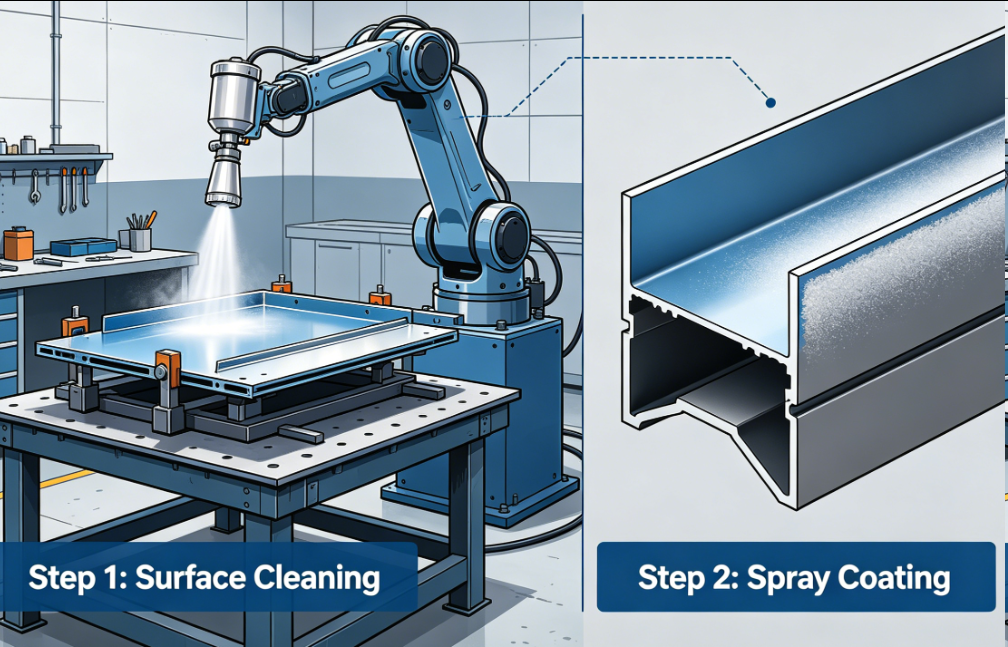
Sheet metal processing surface spraying is a critical post-processing technology that enhances the performance, durability, and aesthetic appeal of sheet metal parts, widely applied in industries such as automotive, aerospace, electronics, and construction. The core purpose of surface spraying is to form a protective and decorative coating on the sheet metal surface, which not only isolates the metal substrate from the external environment to prevent corrosion caused by moisture, oxygen, and chemical substances but also improves the surface finish and appearance consistency of the product. This process involves a series of standardized steps, each of which directly affects the quality and service life of the coating, making it a key link in ensuring the overall quality of sheet metal products.
The full sheet metal spraying process typically includes six critical stages to ensure coating quality, adhesion, and long-term durability. The first stage is sandblasting treatment, which serves two core purposes: surface cleaning and surface texturing. Sandblasting effectively removes oil, rust, and oxide layers from the sheet metal surface, eliminating contaminants that could weaken coating adhesion, while also creating a honeycomb-like rough texture to improve the “grip” for subsequent coating, boosting long-term adhesion and preventing peeling. Uniformity is crucial in sandblasting, as even minor residues or uneven texturing can lead to coating defects in later stages. The second stage is putty application and sanding; for workpieces with surface irregularities such as dents, scratches, or small gaps, workers spread high-adhesion putty evenly to fill gaps, then sand the surface with 400–600 grit fine sandpaper after the putty dries to achieve a flat, smooth finish, avoiding uneven coating thickness later.
After putty sanding, air blowing cleaning is essential to remove tiny dust particles and debris remaining on the workpiece surface, especially in crevices, holes, or recessed areas where particles tend to accumulate. Thorough cleaning is non-negotiable, as any remaining debris will get trapped under the coating, causing bumps, pinholes, or peeling. The fourth stage is electrostatic spraying, completed in a dedicated spray booth using electrostatic principles: the spray gun charges the coating powder (typically polyester or epoxy-based) with static electricity, while the grounded workpiece acts as an opposite charge, ensuring the powder adheres uniformly to all surfaces—including edges and hard-to-reach areas—reducing waste and ensuring consistent thickness. Premium powders, such as Akzo Nobel powders, are often used to enhance coating performance, including resistance to corrosion, impact, and UV damage. Additionally, thermal spraying is another common technique, where melted or heated materials (in powder or wire form) are sprayed onto the surface, suitable for creating thick coatings (20 microns to several mm) and applying refractory materials like oxides. Finally, a curing stage is required to ensure the coating adheres firmly to the substrate, forming a hard, wear-resistant layer that meets the required performance standards.
 China management center add.
204, Building A, Phase 3, Jiewei Industrial Park, Shangmugu Community, Pinghu Street, Longgang District, Shenzhen, China
 Headquarters tel.
+86 134 3077 5139
 E-mail.


 CN
CN


