


Time:2026-04-16 Views:0
Sheet metal processing precision refers to the degree of consistency between the actual size, shape, and position of the sheet metal parts obtained after processing and the designed parameters. It is a core indicator that determines the quality and performance of sheet metal products, directly affecting the assembly accuracy, service life, and functional stability of the final products. In modern manufacturing, with the increasing miniaturization, complexity, and high performance requirements of equipment, the demand for sheet metal processing precision is constantly rising, especially in industries such as aerospace, automotive, electronics, and medical equipment, where even tiny deviations may lead to product failure or safety hazards.
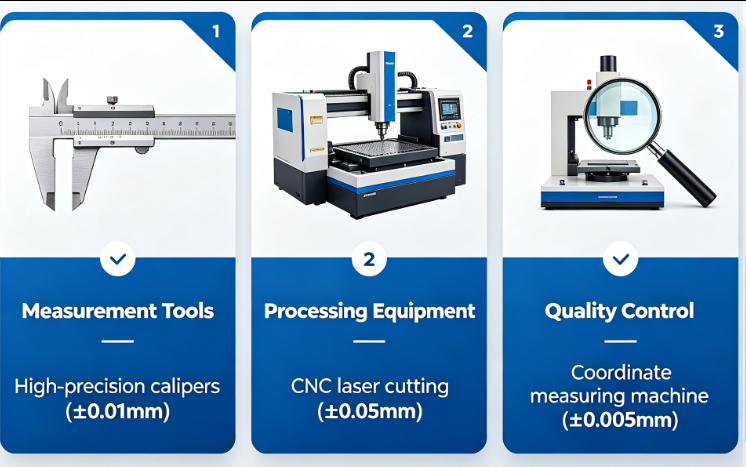
The factors affecting sheet metal processing precision are diverse, including the performance of processing equipment, the quality of raw materials, the rationality of processing technology, the skill level of operators, and the stability of the processing environment. High-precision processing equipment such as CNC laser cutting machines, CNC bending machines, and precision punching machines is the foundation of ensuring processing precision. These equipment can achieve precise control of cutting, bending, and punching processes through computer numerical control, reducing human errors. For example, CNC laser cutting machines can achieve a cutting precision of ±0.1mm, which is far higher than traditional manual cutting or ordinary mechanical cutting. The quality of raw materials also plays a crucial role; uneven thickness, poor flatness, or inconsistent material properties of the sheet metal will lead to uneven stress during processing, resulting in deformation and affecting precision.
To ensure sheet metal processing precision, a series of targeted measures need to be taken. First, it is necessary to select appropriate processing equipment and tools according to the precision requirements of the products, and conduct regular calibration and maintenance of the equipment to ensure its stable performance. Second, strict inspection and control of raw materials should be carried out to eliminate unqualified materials from entering the processing link. Third, a reasonable processing process should be formulated, such as optimizing the cutting sequence, controlling the bending angle and pressure, and reducing the impact of processing stress on precision. In addition, the processing environment should be controlled, such as keeping the temperature and humidity stable, to avoid the impact of environmental factors on the size and shape of sheet metal parts. Finally, strict quality inspection should be carried out after processing, using precision measuring tools such as calipers, micrometers, and coordinate measuring machines to detect the size and shape of the parts, and timely adjust the processing parameters for unqualified products to ensure that the final products meet the precision requirements. With the continuous development of technology, intelligent processing equipment and online detection technology are gradually applied to sheet metal processing, further improving the stability and reliability of processing precision.
 China management center add.
204, Building A, Phase 3, Jiewei Industrial Park, Shangmugu Community, Pinghu Street, Longgang District, Shenzhen, China
 Headquarters tel.
+86 134 3077 5139
 E-mail.


 CN
CN


