

Time:2026-05-06 Views:0
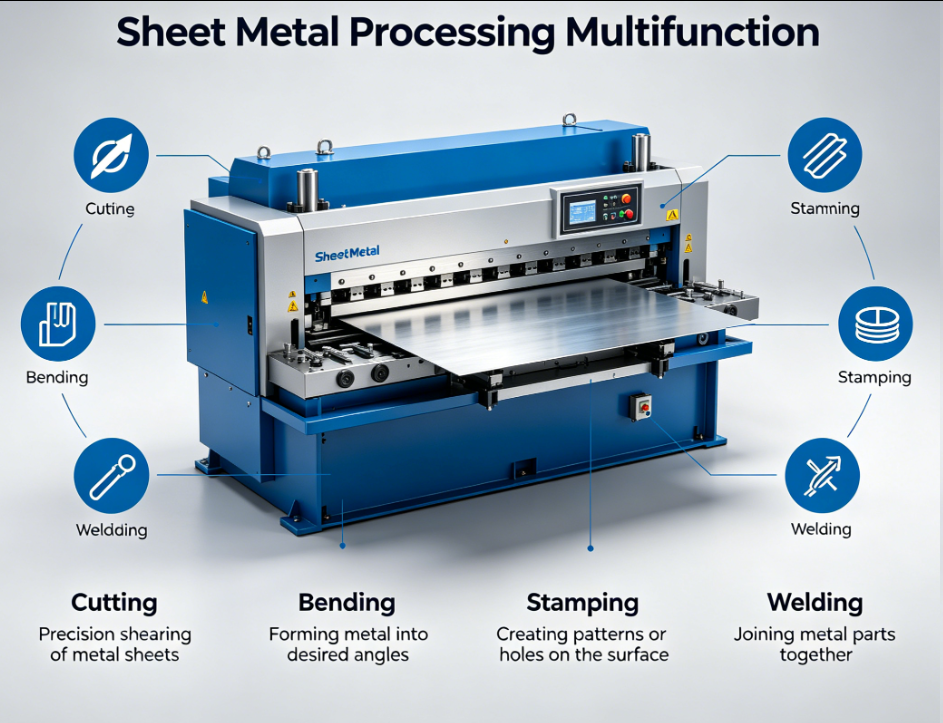
Sheet metal processing is a versatile manufacturing technology that integrates multiple functions to meet the diverse needs of various industries, ranging from automotive and aerospace to electronics, construction, and medical equipment. Its multifunctionality is reflected in the combination of cutting, bending, punching, forming, welding, and surface treatment, allowing a single sheet of metal to be transformed into complex, high-precision components with different shapes and functions. Unlike traditional metal processing methods that focus on a single operation, modern sheet metal processing integrates multiple processes into a coherent production line, improving efficiency while ensuring the consistency and quality of the final products.
One of the core multifunctional features of sheet metal processing is its adaptability to different materials and thicknesses. It can handle a wide range of metals, including steel, aluminum, copper, stainless steel, and various alloys, each requiring specific processing parameters to achieve optimal results. For example, thin-gauge sheet metal (0.1–3mm) is commonly used in electronic enclosures and precision parts, requiring high-precision cutting and bending, while thick-gauge sheet metal (3–20mm) is suitable for structural components in construction and heavy machinery, requiring strong welding and forming capabilities. Additionally, sheet metal processing can realize both functional and decorative functions: functional components such as brackets, chassis, and heat sinks ensure the stability and performance of equipment, while decorative parts such as panels and casings enhance the aesthetic appeal of products through surface treatments like painting, powder coating, and anodizing.
Another embodiment of multifunctionality is the integration of manual, semi-automatic, and automatic operations. Small-batch, customized products can be processed manually or with semi-automatic equipment to reduce costs and improve flexibility, while large-batch, standardized products can be produced using fully automatic production lines, including CNC cutting machines, robotic bending arms, and automatic welding equipment, to achieve high efficiency and low error rates. This combination of flexibility and automation makes sheet metal processing suitable for both prototype development and mass production, meeting the needs of different production scales and product types. Moreover, with the integration of intelligent technologies such as computer-aided design (CAD) and computer-aided manufacturing (CAM), sheet metal processing can realize real-time monitoring, parameter adjustment, and quality inspection, further expanding its functional scope and application fields.
 China management center add.
204, Building A, Phase 3, Jiewei Industrial Park, Shangmugu Community, Pinghu Street, Longgang District, Shenzhen, China
 Headquarters tel.
+86 134 3077 5139
 E-mail.


 CN
CN


