

Time:2026-04-11 Views:0
Selecting the right material is the foundational step in sheet metal processing, as it directly determines the final product’s performance, durability, cost-effectiveness, and adaptability to subsequent processing steps. The core principle of material selection is to balance functional requirements, processing feasibility, and economic benefits—avoiding over-specification that increases costs or under-specification that compromises product quality. Common sheet metal materials include carbon steel, stainless steel, aluminum alloy, copper alloy, and special alloys, each with unique properties tailored to specific application scenarios.
Carbon steel is one of the most widely used materials in sheet metal processing due to its low cost, good machinability, and high strength. Low-carbon steel (e.g., Q235, SPCC) is suitable for general structural parts such as brackets, enclosures, and chassis, as it is easy to cut, bend, and weld without excessive brittleness. Medium-carbon steel (e.g., 45#) offers higher strength and hardness, making it ideal for parts that require load-bearing capacity, such as gears and connecting rods, though it may require heat treatment after processing to improve toughness. High-carbon steel, while extremely hard, is less malleable and more prone to cracking during bending, so it is typically used for specialized components like blades or cutting tools.
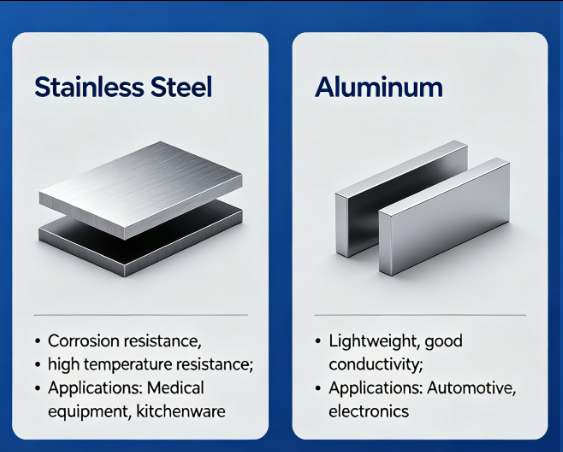
Stainless steel is favored for its corrosion resistance, hygiene, and aesthetic appeal, making it suitable for applications in food processing, medical equipment, chemical industry, and outdoor environments. The most common types are austenitic stainless steel (e.g., 304, 316), which has excellent formability and weldability, and ferritic stainless steel (e.g., 430), which is more cost-effective but less corrosion-resistant than austenitic grades. 316 stainless steel, in particular, contains molybdenum, enhancing its resistance to saltwater and harsh chemicals, making it ideal for marine and coastal applications.
Aluminum alloy is lightweight, has good thermal and electrical conductivity, and is easy to form and anodize, making it popular in aerospace, automotive, electronics, and decorative industries. Common grades include 5052, 6061, and 1060: 1060 is pure aluminum with excellent ductility, suitable for decorative parts and heat exchangers; 5052 has high corrosion resistance and strength, ideal for marine and automotive components; 6061 is a heat-treatable alloy with good weldability and strength, widely used in structural parts and machinery. Copper alloy, though more expensive, offers superior electrical conductivity and is used in electrical components, connectors, and heat sinks. When selecting materials, factors such as environmental conditions (temperature, humidity, corrosion), load requirements, processing methods (cutting, bending, welding), and cost must be comprehensively considered to ensure optimal product performance and economic efficiency.
 China management center add.
204, Building A, Phase 3, Jiewei Industrial Park, Shangmugu Community, Pinghu Street, Longgang District, Shenzhen, China
 Headquarters tel.
+86 134 3077 5139
 E-mail.


 CN
CN


