

Time:2026-04-01 Views:0
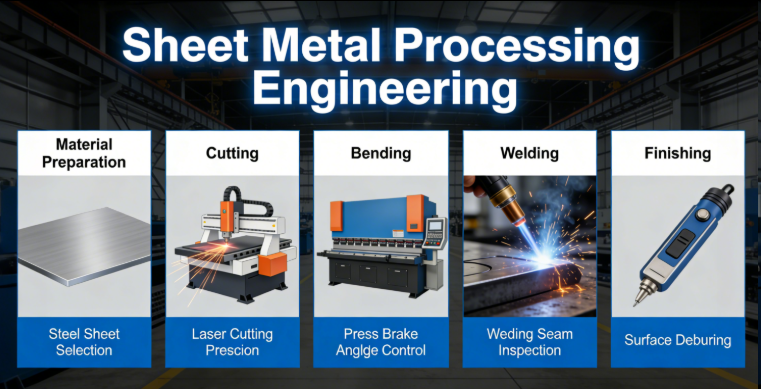
Sheet metal processing engineering refers to a systematic project that integrates design, processing, assembly, and inspection, aiming to provide complete sheet metal solutions for various industries, including the design of sheet metal structures, the selection of processing technologies, the operation of processing equipment, the assembly of finished products, and the quality control of the entire process. Sheet metal processing engineering has strong professionalism and comprehensiveness, involving multiple disciplines such as mechanical design, material science, processing technology, and quality inspection, and is widely used in machinery manufacturing, electronic equipment, automotive industry, aerospace, architectural decoration, and other fields, playing an important role in promoting the development of various industries.
The whole process of sheet metal processing engineering usually includes project demand analysis, structural design, material selection, process planning, processing and manufacturing, assembly and debugging, quality inspection, and after-sales service. Project demand analysis is the starting point of the project, which requires the engineering team to fully communicate with the customer, understand the customer's needs for the sheet metal product, including structural size, performance indicators, use environment, delivery time, and cost budget, so as to formulate a scientific and reasonable project implementation plan. Structural design is a key link, where designers use professional software such as CAD and SolidWorks to design the sheet metal structure, considering factors such as structural strength, stability, processing feasibility, and cost, and conduct simulation analysis and optimization to ensure the rationality and reliability of the design.
Material selection is closely related to the performance and service life of the product. According to the use environment and functional requirements of the product, the engineering team selects appropriate sheet metal materials, such as carbon steel, stainless steel, aluminum alloy, and copper alloy, and determines the material thickness and specifications to ensure that the product meets the design requirements. Process planning is to formulate a detailed processing flow according to the structural design and material characteristics, including cutting, bending, stamping, welding, surface treatment, and other processes, and select appropriate processing equipment and technologies to ensure the processing efficiency and quality. Processing and manufacturing is the core link of the project, where the processing team uses professional equipment to process the sheet metal materials according to the process requirements, and strictly controls the processing precision and quality.
Assembly and debugging is to assemble the processed sheet metal parts into finished products, and debug the products to ensure that their performance meets the design standards. Quality inspection runs through the entire project process, including incoming inspection of materials, in-process inspection of processing, and final inspection of finished products, to ensure that there are no quality problems in each link. After-sales service is an important part of sheet metal processing engineering, including product installation guidance, maintenance, and repair, to solve the problems encountered by customers in the use process and improve customer satisfaction. A complete sheet metal processing engineering project requires close cooperation between the design team, processing team, and quality inspection team to ensure the smooth progress of the project and the quality of the final product. China management center add.
204, Building A, Phase 3, Jiewei Industrial Park, Shangmugu Community, Pinghu Street, Longgang District, Shenzhen, China
 Headquarters tel.
+86 134 3077 5139
 E-mail.


 CN
CN


