

Time:2026-04-10 Views:0
Sheet metal processing automation equipment has revolutionized the manufacturing industry by improving production efficiency, reducing labor costs, ensuring consistent product quality, and enhancing workplace safety. With the rapid development of Industry 4.0 and intelligent manufacturing, automation equipment has become an essential part of modern sheet metal processing workshops, covering the entire production process from material loading and cutting to bending, welding, and finishing. The core advantage of automation equipment is its ability to perform repetitive, high-precision operations continuously, reducing human error and improving production stability, especially for large-batch production.
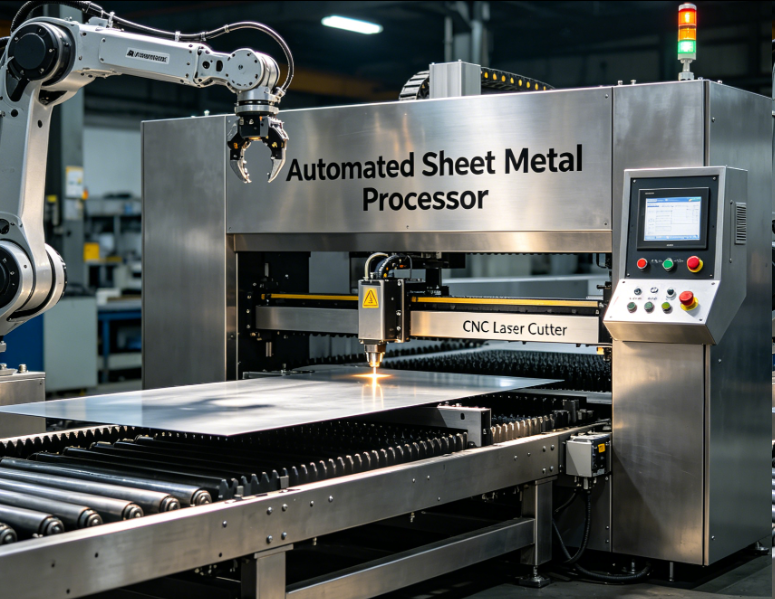
Automated loading and unloading systems are the foundation of sheet metal processing automation, used to transport raw materials and finished parts between different processing equipment, eliminating manual handling and improving production efficiency. Common automated loading and unloading equipment includes robotic arms, gantry loaders, and conveyor systems. Robotic arms are highly flexible, able to adapt to different material sizes and shapes, and can be integrated with cutting, bending, and welding equipment to form a fully automated production line. They are suitable for complex, high-precision loading and unloading operations, such as loading raw sheets into laser cutting machines and unloading finished parts onto conveyor belts. Gantry loaders are suitable for large-scale, heavy-duty sheet metal processing, with high stability and load-bearing capacity, able to transport large sheets between shearing machines, punch presses, and other equipment. Conveyor systems are used for continuous transportation of parts between different processing stations, such as from cutting to bending, or from welding to surface treatment, improving production continuity.
Automated cutting and bending equipment are key components of sheet metal processing automation, integrating computer numerical control (CNC) technology with mechanical systems to achieve high-precision, high-efficiency processing. CNC laser cutting machines with automatic nesting software can optimize the layout of raw materials, reduce material waste, and automatically cut multiple parts continuously without manual intervention. Automated press brakes are equipped with CNC control systems and robotic arms for automatic bending, able to adjust bending angles, pressure, and speed according to pre-programmed parameters, ensuring consistent bending quality for each part. Some advanced automated bending equipment also has adaptive bending technology, which can automatically adjust parameters based on material thickness and hardness, improving processing accuracy and reducing setup time.
Automated welding and finishing equipment further enhance the automation level of sheet metal processing. Automated welding robots are widely used for joining sheet metal parts, with high welding speed, precision, and consistency, reducing the need for skilled welders and improving welding quality. They can be programmed to perform complex welding paths, such as circular, linear, or irregular welds, and are suitable for large-batch production of automotive parts, electrical enclosures, and other components. Automated finishing equipment, such as robotic sandblasting machines and automatic coating lines, can perform surface treatment operations continuously, ensuring uniform coating thickness and surface quality, and reducing manual labor. In addition, intelligent monitoring and control systems are integrated into automated equipment, allowing real-time monitoring of production parameters (such as cutting speed, bending angle, and welding temperature), early detection of equipment faults, and remote control of production processes, improving production management efficiency and reducing downtime.
When selecting sheet metal processing automation equipment, factors such as production volume, part complexity, processing accuracy, material type, and budget must be considered. For large-batch, standardized production, fully automated production lines (integrating loading, cutting, bending, welding, and finishing) are the best choice, as they can maximize production efficiency and reduce labor costs. For small to medium-batch, multi-variety production, flexible automation equipment (such as robotic arms and CNC machines) is more suitable, as it can be quickly adjusted to process different parts. In addition, the compatibility and scalability of automation equipment should be considered to ensure that it can be integrated with existing equipment and upgraded to meet future production needs.
 China management center add.
204, Building A, Phase 3, Jiewei Industrial Park, Shangmugu Community, Pinghu Street, Longgang District, Shenzhen, China
 Headquarters tel.
+86 134 3077 5139
 E-mail.


 CN
CN


