

Time:2026-01-29 Views:0
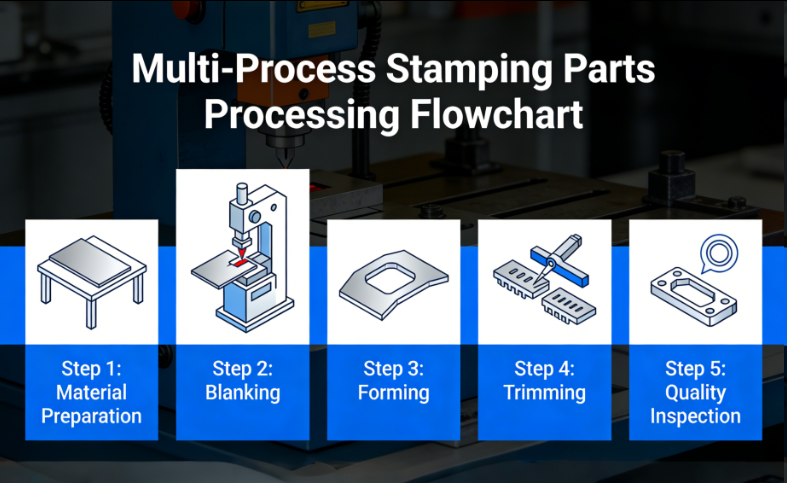
Multi-process stamping, also known as progressive die stamping, is an advanced manufacturing method that combines multiple stamping operations—such as blanking, piercing, bending, drawing, and flanging—into a single, continuous process using a progressive die set. This integrated approach allows a raw metal coil to be fed through a series of stations, each performing a specific operation, until the final part is completed and separated from the remaining material.
The efficiency of multi-process stamping lies in its automation and speed, making it ideal for high-volume production of complex parts with tight tolerances. Each station in the progressive die is precisely aligned to ensure that the part is accurately positioned for each subsequent operation, reducing the risk of errors and ensuring consistency across thousands or millions of parts. This method eliminates the need for manual handling between processes, minimizing production time and labor costs while improving safety.
Designing a progressive die requires careful planning to determine the sequence of operations, with consideration given to material flow, tooling durability, and the part’s final geometry. Modern multi-process stamping systems often incorporate computer-aided design (CAD) and simulation software to optimize the die layout and predict potential issues like material thinning or tool wear. Industries such as automotive, consumer electronics, and aerospace rely on this process to produce intricate parts—from connector pins to engine components—with high efficiency and reliability.
 China management center add.
204, Building A, Phase 3, Jiewei Industrial Park, Shangmugu Community, Pinghu Street, Longgang District, Shenzhen, China
 Headquarters tel.
+86 134 3077 5139
 E-mail.


 CN
CN


