

Time:2026-04-22 Views:0
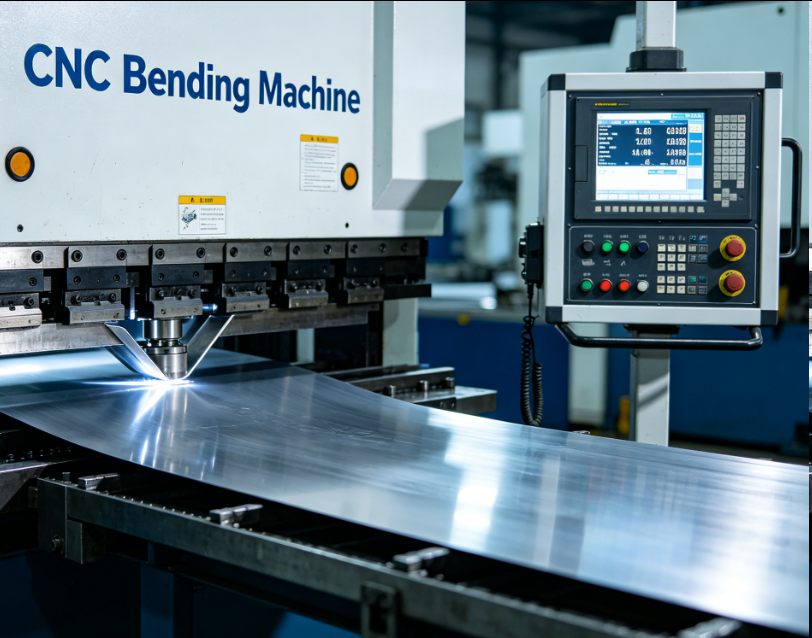
CNC numerical control bending processing is a precision metal forming technology that uses computer numerical control systems to control the movement of bending machines, enabling accurate and consistent bending of metal sheets into various shapes. This technology has become an indispensable part of modern manufacturing, widely used in industries such as automotive, aerospace, electronics, and construction. Unlike traditional manual bending, CNC bending eliminates human errors caused by manual operation, ensuring that each workpiece meets the strict dimensional requirements of design drawings. The core advantage of CNC bending lies in its high automation, which not only improves production efficiency but also reduces labor costs and reduces the risk of work-related injuries.
The working principle of CNC bending involves inputting the design parameters (such as bending angle, bending radius, and sheet thickness) into the CNC system, which then controls the hydraulic or electric drive system to drive the upper and lower dies to move precisely. The CNC system can store multiple sets of processing programs, allowing for quick switching between different workpieces, which is particularly suitable for mass production and small-batch, multi-variety production. In addition, modern CNC bending machines are often equipped with advanced functions such as automatic sheet feeding, angle compensation, and real-time error detection, further improving processing accuracy and stability. For example, in the automotive industry, CNC bending is used to process body parts, chassis components, and exhaust systems, where even a slight dimensional deviation can affect the overall performance and safety of the vehicle.
Another key feature of CNC bending is its versatility. It can process a variety of metal materials, including carbon steel, stainless steel, aluminum alloy, and copper alloy, with sheet thickness ranging from a few millimeters to dozens of millimeters. Different dies can be replaced according to the shape requirements of the workpiece, enabling the processing of complex shapes such as U-bends, V-bends, and multi-step bends. With the continuous development of technology, CNC bending machines are becoming more intelligent. Some advanced models are equipped with 3D simulation functions, which can simulate the bending process before actual processing, predict potential problems such as material deformation and die interference, and adjust parameters in advance to avoid waste of materials and time. This intelligent upgrade has greatly improved the reliability and efficiency of CNC bending processing, making it more adaptable to the increasingly complex and precise requirements of modern manufacturing.
In terms of quality control, CNC bending processing ensures high consistency of workpieces. The CNC system can accurately control the bending force and speed, ensuring that each workpiece has the same bending angle and dimensional accuracy. This is crucial for industries that require high assembly accuracy, such as the aerospace industry, where components processed by CNC bending must fit perfectly with other parts to ensure the safety and reliability of aircraft. Moreover, CNC bending processing reduces the need for post-processing, as the processed workpieces have smooth surfaces and accurate dimensions, which can be directly used for assembly, saving time and cost. In summary, CNC numerical control bending processing is a high-precision, high-efficiency, and versatile metal forming technology that plays a vital role in promoting the development of modern manufacturing.
 China management center add.
204, Building A, Phase 3, Jiewei Industrial Park, Shangmugu Community, Pinghu Street, Longgang District, Shenzhen, China
 Headquarters tel.
+86 134 3077 5139
 E-mail.


 CN
CN


