



Time:2026-04-08 Views:0
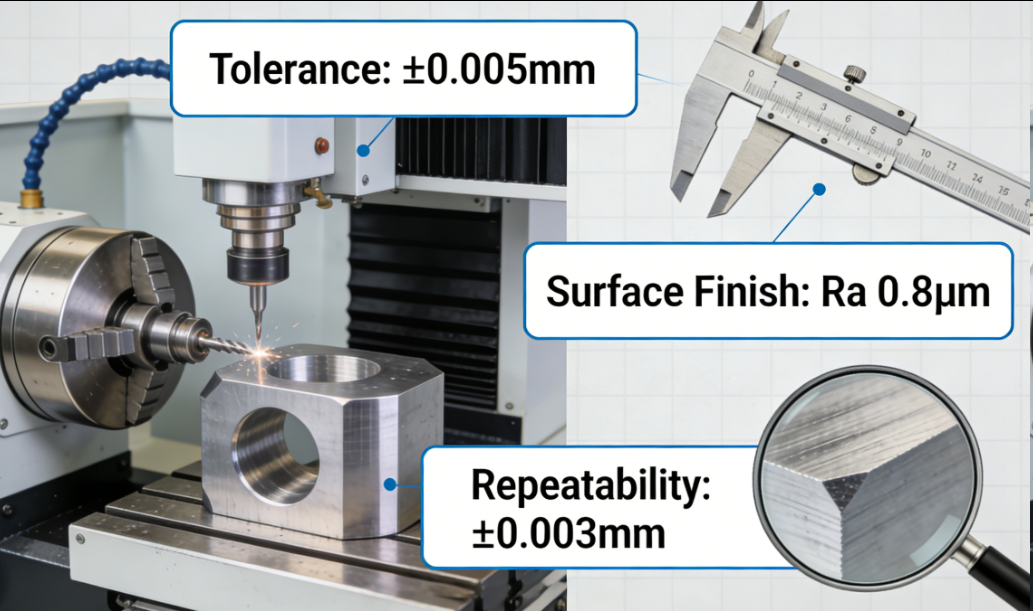
CNC machining accuracy refers to the degree to which a CNC machine can produce parts that match the exact dimensions, shapes, and surface finishes specified in the design图纸. It is a critical parameter in manufacturing, as even minor deviations from the intended specifications can compromise the functionality, reliability, and interchangeability of components. CNC machining accuracy is influenced by a combination of machine performance, tool quality, programming precision, environmental conditions, and operator skill, making it a multifaceted aspect of the machining process. Achieving high accuracy is essential for industries that require tight tolerances, such as aerospace, medical devices, automotive, and precision engineering.
There are two key components of CNC machining accuracy: positional accuracy and geometric accuracy. Positional accuracy refers to the ability of the machine’s tool or workpiece to move to a specified position along the machine’s axes (X, Y, Z, and additional rotational axes for multi-axis machines) with minimal error. This is measured using tools like laser interferometers, which detect deviations in axis movement and provide data for calibration. Geometric accuracy, on the other hand, refers to the precision of the machine’s components and their alignment, including the straightness of the axes, the flatness of the worktable, the squareness of the axes relative to each other, and the parallelism of moving parts. Poor geometric accuracy can lead to distorted parts, uneven surface finishes, and reduced part performance.
Several factors can degrade CNC machining accuracy if not properly controlled. Machine rigidity is a primary factor—vibrations caused by loose components, insufficient clamping, or high cutting forces can cause the tool or workpiece to move unexpectedly, leading to dimensional errors. Tool wear and tool runout (the deviation of the tool’s rotation from its center axis) also affect accuracy; dull tools or tools with poor concentricity can produce inconsistent cuts and rough surface finishes. Environmental conditions, such as temperature changes, humidity, and vibration from nearby equipment, can cause thermal expansion or contraction of the machine and workpiece, leading to deviations. Additionally, programming errors—such as incorrect tool paths, miscalculated cutting parameters, or errors in the coordinate system—can result in inaccurate parts.
To maintain and improve CNC machining accuracy, manufacturers implement several best practices. Regular machine calibration is essential, using specialized equipment to measure and correct deviations in axis movement, geometric alignment, and tool positioning. Proper tool selection and maintenance—including using high-quality, sharp tools, and replacing worn tools promptly—help ensure consistent cutting performance. Environmental controls, such as temperature-controlled workshops and vibration-damping foundations, minimize external influences. Additionally, using advanced CAD/CAM software to generate precise tool paths, and conducting dry runs and test cuts before full production, helps detect and correct programming errors. As CNC technology advances, features like real-time error correction, adaptive control, and machine learning algorithms are being integrated into CNC systems to further enhance accuracy and reduce human error, making high-precision machining more accessible and reliable.
 China management center add.
204, Building A, Phase 3, Jiewei Industrial Park, Shangmugu Community, Pinghu Street, Longgang District, Shenzhen, China
 Headquarters tel.
+86 134 3077 5139
 E-mail.


 CN
CN


