

Time:2026-04-09 Views:0
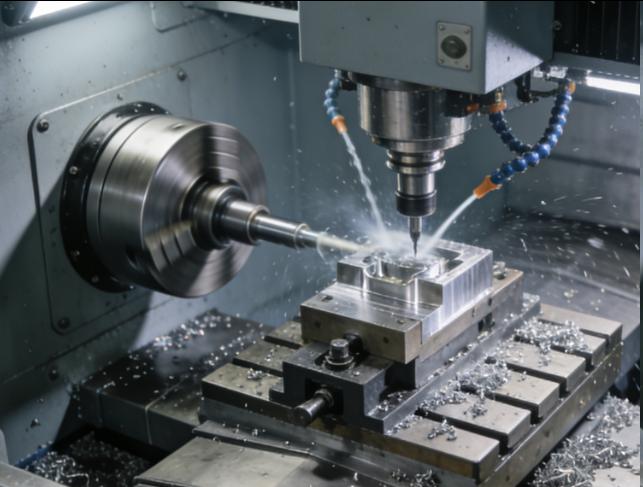
CNC lathe parts processing is a precision manufacturing method that uses computer numerical control (CNC) lathes to produce cylindrical or conical parts by rotating the workpiece while a stationary cutting tool removes material. This process is ideal for producing parts with symmetrical features, such as shafts, bolts, bushings, gears, and cylinders, and is widely used in industries such as automotive, aerospace, medical, electronics, and industrial machinery. CNC lathe parts processing offers high accuracy, repeatability, and efficiency, making it a preferred choice for both small-batch and large-scale production.
The process of CNC lathe parts processing begins with part design and programming. Engineers use CAD software to create a 2D or 3D model of the part, specifying its dimensions, tolerances, surface finish, and material. This model is then converted into G-code using CAM software, which defines the tool path, cutting parameters (spindle speed, feed rate, depth of cut), and sequence of operations. Common operations in CNC lathe parts processing include turning (removing material from the outer diameter of the workpiece), facing (creating a flat surface on the end of the workpiece), threading (cutting internal or external threads), grooving (cutting slots or grooves), and boring (enlarging existing holes).
Once the program is generated, the CNC lathe is set up with the appropriate cutting tools, workpiece fixture, and material. The workpiece is secured to the lathe’s chuck or collet, which rotates the workpiece at a speed determined by the program. The cutting tool is mounted on a tool turret, which moves along the X and Z axes to remove material from the rotating workpiece. The CNC controller interprets the G-code, controlling the movement of the tool turret and the rotation of the workpiece to ensure precise material removal. Coolant is often used during machining to reduce heat, lubricate the cutting tool, and improve surface finish, as well as to flush away chips and debris.
Quality control is an essential part of CNC lathe parts processing. After machining, the part is inspected to verify that it meets the specified dimensions and tolerances. This is typically done using tools such as calipers, micrometers, thread gauges, and coordinate measuring machines (CMMs). Surface finish is also inspected to ensure it meets the required smoothness or texture. Additionally, material testing may be performed to confirm that the part’s material properties (such as hardness, strength, and corrosion resistance) are suitable for its intended application. Advances in CNC lathe technology, such as live tooling (which allows for milling and drilling operations on the lathe), multi-axis capabilities, and automated tool changers, have expanded the range of parts that can be produced and improved production efficiency. CNC lathe parts processing remains a critical component of modern manufacturing, providing the precision and consistency needed for high-quality cylindrical parts.
 China management center add.
204, Building A, Phase 3, Jiewei Industrial Park, Shangmugu Community, Pinghu Street, Longgang District, Shenzhen, China
 Headquarters tel.
+86 134 3077 5139
 E-mail.


 CN
CN


