



Time:2026-04-03 Views:0
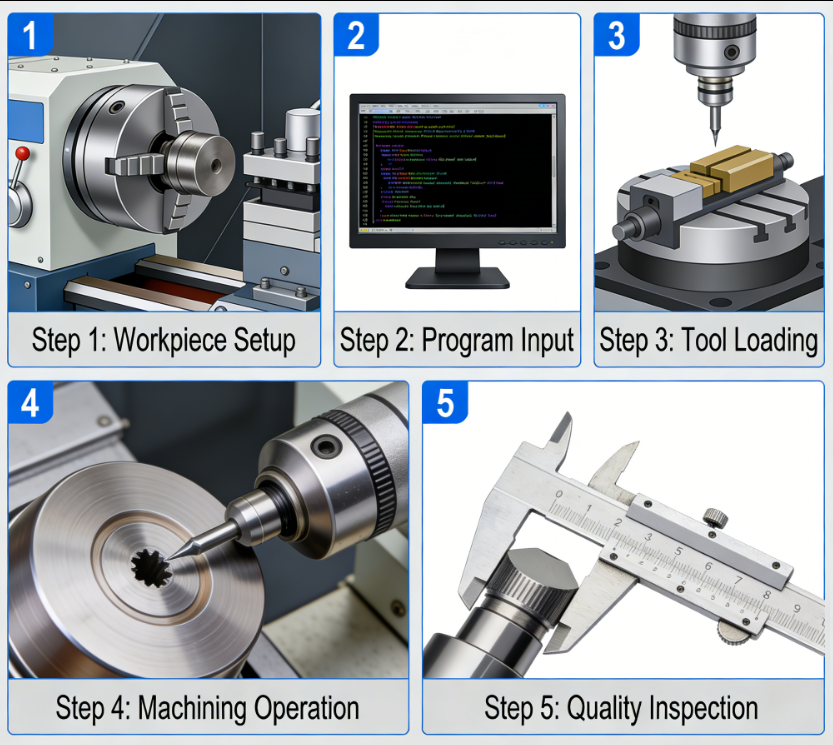
CNC lathe machining process is a specialized turning process that uses computer numerical control technology to control the movement of the lathe spindle and tool turret, realizing the high-precision processing of cylindrical, conical, and other axisymmetric parts. It is one of the most widely used processes in CNC machining, mainly used for processing rotating parts such as shafts, bushings, bearings, pins, and fasteners. Compared with traditional manual lathes, CNC lathes have the advantages of high processing precision, strong repeatability, high efficiency, and low labor intensity, and can process complex rotating parts that are difficult to achieve by manual operation.
The core principle of the CNC lathe machining process is to rotate the workpiece at high speed through the spindle, while the tool turret drives the cutting tool to move along the axial and radial directions of the workpiece, removing material from the surface of the workpiece to form the desired shape and size. The entire process is controlled by a pre-programmed CNC program, which eliminates the influence of human factors and ensures the consistency of processing quality. The CNC lathe machining process can be divided into several stages according to the processing sequence: rough turning, semi-finish turning, finish turning, and post-processing. Rough turning is mainly used to remove a large amount of excess material from the blank, improving processing efficiency; semi-finish turning is used to improve the dimensional accuracy and surface quality of the workpiece, laying the foundation for finish turning; finish turning is the final processing stage, which ensures that the workpiece meets the design’s dimensional tolerance and surface roughness requirements.
The key links of the CNC lathe machining process include programming, workpiece clamping, tool selection, cutting parameter setting, and processing operation. Programming is the premise of the process. Engineers use CAD/CAM software to design the part model and generate the turning program, which includes the tool path, spindle speed, feed rate, and cutting depth. Workpiece clamping is crucial to processing precision. The workpiece needs to be firmly clamped on the spindle chuck to avoid displacement during rotation, which may lead to processing errors. Tool selection should be based on the material of the workpiece and the processing requirements. For example, carbide tools are suitable for high-speed turning of metal materials, while diamond tools are suitable for processing high-precision and high-surface-quality parts. Cutting parameter setting directly affects processing efficiency and tool life. Reasonable parameters can reduce tool wear, improve processing efficiency, and ensure processing quality.
In practical applications, CNC lathe machining process is widely used in automotive, aerospace, machinery manufacturing, and other industries. For example, in the automotive industry, it is used to process crankshafts, camshafts, and other key components; in the aerospace industry, it is used to process engine shafts and other precision rotating parts. With the development of technology, CNC lathe machining process is constantly upgrading, and the integration of intelligent technologies such as AI adaptive processing and real-time monitoring has further improved the processing efficiency and precision. In addition, the emergence of compound CNC lathes (such as turning-milling compound lathes) has realized the integration of multiple processes such as turning, milling, and drilling, reducing the number of clamping times and improving production efficiency.
 China management center add.
204, Building A, Phase 3, Jiewei Industrial Park, Shangmugu Community, Pinghu Street, Longgang District, Shenzhen, China
 Headquarters tel.
+86 134 3077 5139
 E-mail.


 CN
CN


