

Time:2026-04-15 Views:0
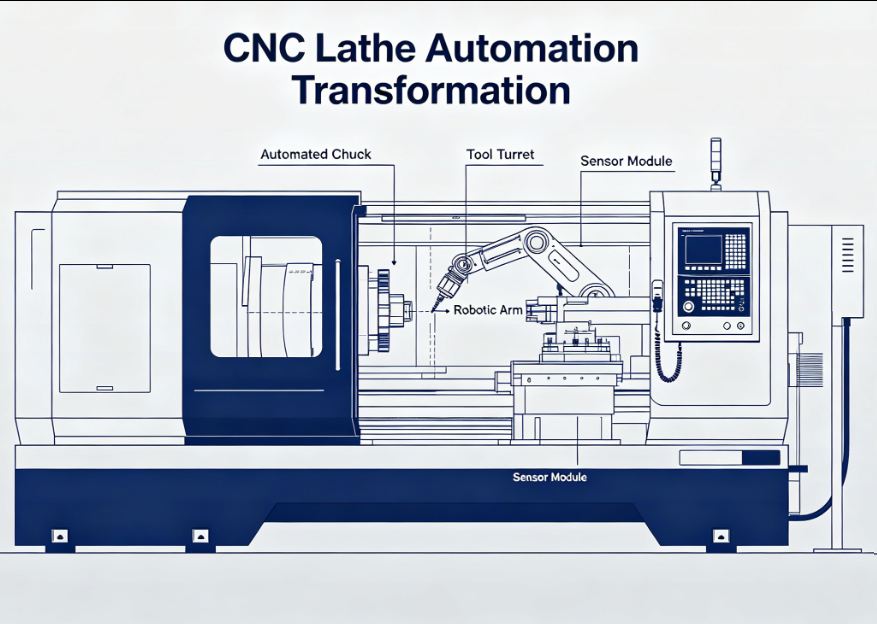
CNC lathe automation transformation refers to the process of upgrading traditional CNC lathes or conventional lathes with advanced automated systems and components to reduce manual intervention, improve production efficiency, enhance machining precision, and lower operational costs. In modern manufacturing, as the demand for high-volume, high-precision parts continues to grow, automation transformation has become a critical measure for enterprises to improve their competitiveness. Unlike traditional manual or semi-automatic lathe operations that rely heavily on skilled operators to control tool movement, feed rates, and workpiece clamping, automated CNC lathes can complete the entire machining process from workpiece loading and clamping to cutting, measuring, and unloading without continuous human supervision. This transformation not only addresses the limitations of manual operations, such as low efficiency, high error rates, and difficulty in ensuring consistent quality, but also adapts to the trend of intelligent manufacturing.
The core components of CNC lathe automation transformation include automatic loading and unloading systems, CNC control system upgrades, tool change automation, and real-time monitoring systems. Automatic loading and unloading systems, such as robotic arms, gantry loaders, or conveyor belt systems, replace manual workpiece handling, which not only improves loading efficiency but also reduces the risk of workpiece damage and operator safety hazards. Upgrading the CNC control system to a more advanced model enables more complex programming, better motion control, and integration with other automated equipment, allowing for seamless coordination between different machining processes. Automatic tool changers (ATCs), such as turret-style or magazine-style ATCs, eliminate the need for manual tool replacement, reducing setup time and improving production continuity. Real-time monitoring systems, equipped with sensors and data analysis tools, can track machining parameters, tool wear, and workpiece quality in real time, enabling timely adjustments and predictive maintenance to minimize downtime.
The benefits of CNC lathe automation transformation are multifaceted. From a production perspective, it significantly increases machining efficiency by reducing non-cutting time, such as loading, unloading, and tool changing, allowing for 24/7 continuous operation. In terms of quality, automation eliminates human errors caused by fatigue, skill differences, or operational negligence, ensuring consistent dimensional accuracy and surface finish of machined parts. Additionally, it reduces labor costs by reducing the number of operators required, and improves workplace safety by minimizing operator contact with rotating parts and sharp tools. For enterprises, this transformation also enhances flexibility, as automated systems can be quickly reprogrammed to adapt to different workpiece specifications, making it easier to handle small-batch, multi-variety production tasks. Despite the initial investment in equipment and transformation, the long-term cost savings and efficiency improvements make CNC lathe automation transformation a worthwhile investment for manufacturing enterprises aiming to stay competitive in the global market.
 China management center add.
204, Building A, Phase 3, Jiewei Industrial Park, Shangmugu Community, Pinghu Street, Longgang District, Shenzhen, China
 Headquarters tel.
+86 134 3077 5139
 E-mail.


 CN
CN


