

Time:2026-03-10 Views:0
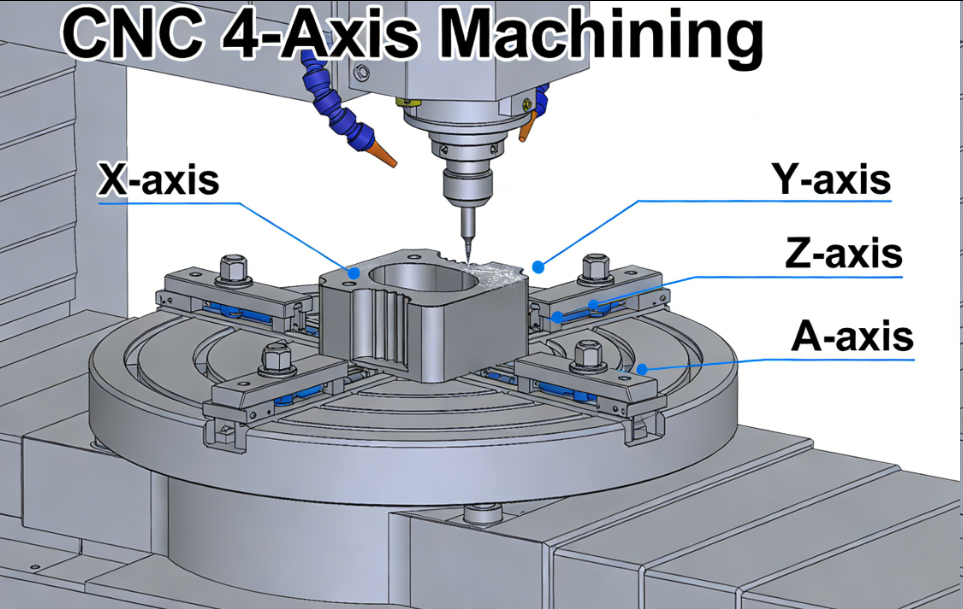
CNC 4-axis machining is an advanced manufacturing technology that builds on the capabilities of 3-axis systems by adding a rotational axis (typically the A-axis, which rotates around the X-axis). This additional degree of freedom enables the machine to manipulate the workpiece or cutting tool in a more complex manner, significantly expanding the range of parts that can be produced with high precision. Unlike 3-axis machining, which is limited to linear movements along the X, Y, and Z axes, 4-axis machining allows for continuous rotation during the cutting process, making it ideal for parts with cylindrical features, angled surfaces, or complex contours that would be difficult or impossible to machine with traditional methods.
One of the key advantages of CNC 4-axis machining is its ability to reduce setup times and improve production efficiency. By eliminating the need for multiple setups to machine different sides of a part, manufacturers can minimize the risk of errors caused by repositioning the workpiece and reduce overall production time. This makes the technology particularly well-suited for high-volume production runs, as well as for producing complex components in industries such as aerospace, automotive, and medical device manufacturing. For example, in the aerospace industry, 4-axis machining is used to produce turbine blades, which require precise angled cuts and smooth surface finishes to ensure optimal performance.
Another benefit of CNC 4-axis machining is its superior precision and repeatability. Modern 4-axis CNC machines are equipped with advanced control systems that can execute complex toolpaths with micron-level accuracy, ensuring that each part produced is identical to the next. This level of precision is critical for applications where component performance and reliability are paramount, such as in medical implants or automotive transmission parts. Additionally, the integration of advanced software tools, such as CAD/CAM systems, allows for seamless design-to-production workflows, enabling manufacturers to quickly translate design concepts into finished parts while maintaining tight tolerances.
 China management center add.
204, Building A, Phase 3, Jiewei Industrial Park, Shangmugu Community, Pinghu Street, Longgang District, Shenzhen, China
 Headquarters tel.
+86 134 3077 5139
 E-mail.


 CN
CN


